
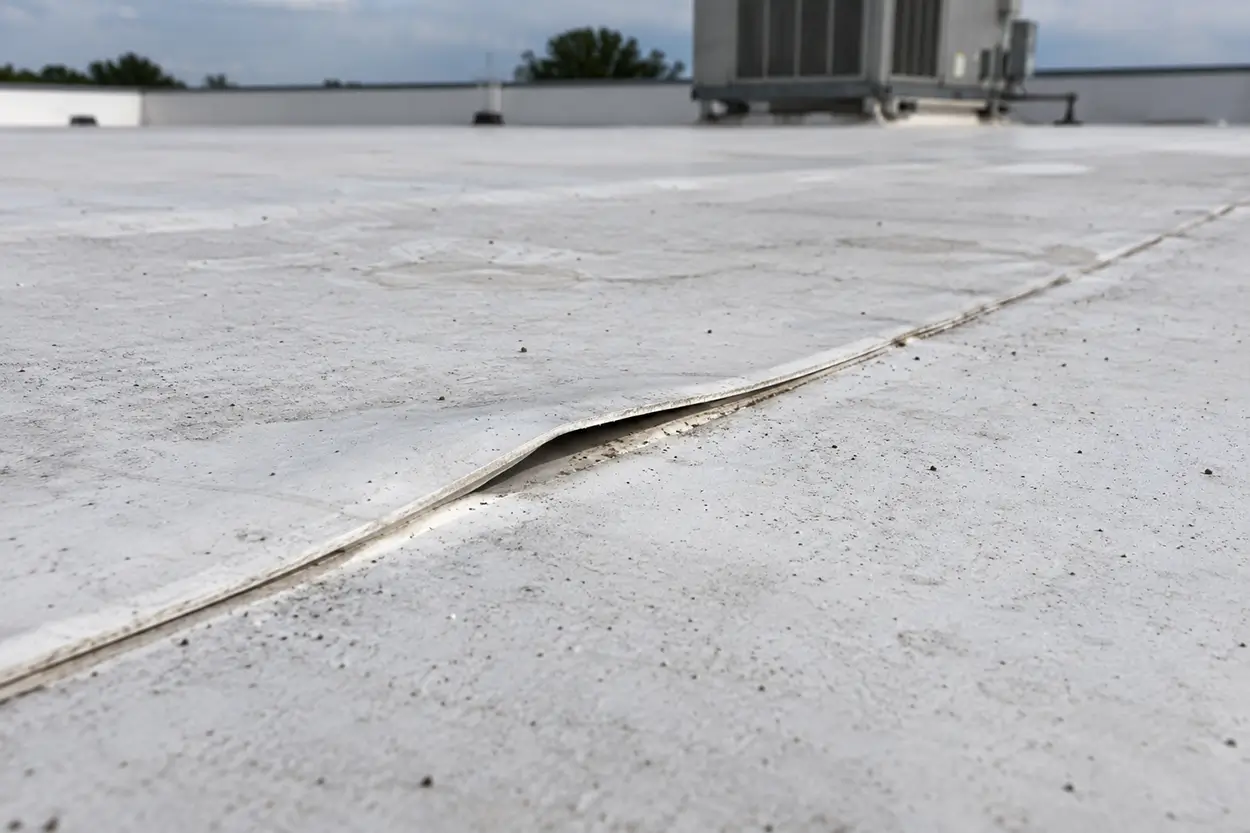
A roofing inspection photo shows a lifted edge where two white membrane sheets meet. The roof may have a leak, or the seam may have been flagged before water appeared inside. Either way, you need to know whether this is one repairable defect or evidence of a problem that extends farther across the building. A useful assessment of TPO roof seam failure should answer that question before you approve the work.
For a commercial property owner in Spring or North Houston, the immediate concern is practical: what needs attention now, and what evidence supports the proposed repair? Start by separating a suspected opening from a confirmed defect, then ask how the contractor will establish its full extent.
What an Open Seam Actually Means
TPO roofing uses overlapping membrane sheets joined with hot-air welding. The weld fuses the overlapping surfaces, creating a continuous connection along the seam. If part of that connection is absent or separates, the opening can provide a route for water beneath the membrane, so the condition deserves prompt professional attention.
Why TPO Roof Seams Can Fail
An inadequate original weld is one possible explanation for TPO roof seam separation. GAF’s installation guidance explains that dirty or damp welding surfaces interfere with fusion, while equipment setup and changing weather conditions affect the welding process. A seam can therefore look joined without having the bond it needs. The roof’s age or the timing of a recent storm does not, by itself, establish why a particular seam opened.
A previous repair also deserves a close look, particularly where new material was joined to an older, weathered surface. Ask the roofer to distinguish a weld defect from damage to the membrane beside it, and to explain which observations support the diagnosis.
A Photograph Cannot Confirm the Weld
Photographs are useful for locating lifted edges, wrinkles, and visible gaps, but seam integrity requires more than a surface view. Carlisle’s seam-checking guidance describes professional probing along cooled weld edges to find areas where the layers have not bonded. This is controlled work with a suitable tool, not an invitation to lift edges with a screwdriver.
The report should identify where the opening starts and stops. If several defects appear along the same seam, ask whether adjacent lengths and comparable details have been checked as well. A close-up of one gap cannot tell you how much of the surrounding seam is sound. Request both a detail photo and a wider view that locates the defect on the roof.
When an interior leak prompted the visit, the inspection should also consider nearby roof details rather than stopping at the first suspicious seam. Carlisle’s inspection guidance includes flashings at penetrations, curbs, and drains, which helps explain why the evaluation needs to consider more than the field membrane alone.
What a TPO Seam Repair Should Include
A repair proposal should name the existing membrane and the compatible materials being used. The method needs to follow that roof manufacturer’s current instructions for the condition found. An older open seam should not automatically be treated like a fresh installation seam that can simply be welded again.
Surface preparation matters just as much as the visible patch. GAF’s seam-cleaning bulletin distinguishes ordinary dirt from weathering and chemical contamination because those conditions need different treatment. Some contamination may prevent an adequate weld even after attempted cleaning. Before accepting a proposal to cover an old repair, ask whether the contractor has established that the surrounding membrane is suitable for the intended bond.
Depending on the defect and the applicable system instructions, the repair may involve a localized patch or a wider membrane overlay along the affected seam. Manufacturer guidance also calls for repaired heat-welded seams to be checked after cooling. Ask for the completed repair photos and confirmation that this check was performed; a neat appearance alone is not the same evidence.
When the Inspection Needs to Go Beyond One Seam
One confirmed defect does not establish that every seam has failed. Equally, a small visible gap does not establish that the work can stop at the surface. If there has been leakage, ask how the roofer will determine whether insulation or other materials beneath the membrane have become wet and whether additional investigation is needed.
Closing the entry point and addressing existing moisture are separate parts of the repair decision. GAF’s requirements for preparing an existing TPO roof for a liquid-applied system, for example, call for replacing wet insulation rather than covering it. The precise scope for your roof should follow the actual findings, including any affected underlying materials. Repeated defects in different areas warrant a broader assessment before a series of isolated patches is approved.
Ask for a Repair Scope You Can Check
Before authorizing TPO seam repair, ask the contractor to put the findings and proposed work in the same written scope. It should identify the affected locations and lengths, the preparation and repair materials, any work needed below the membrane, and how the finished seams will be checked. If the estimate says only “seal seams,” request enough detail to understand what that includes. Keep the report and completion photos with the building’s roof records so a later inspection has something useful to compare.
Get the Suspected Seam Assessed
If you are arranging commercial TPO roof repair in Spring, TX, Royal Crown Roofing can help you take the next step with its commercial roof repair services and experience with TPO roofing systems. Share the inspection photos, leak locations, and any earlier repair records when requesting an assessment. That gives the conversation a clear starting point: confirm the defect, establish its extent, and discuss the work the findings support.