
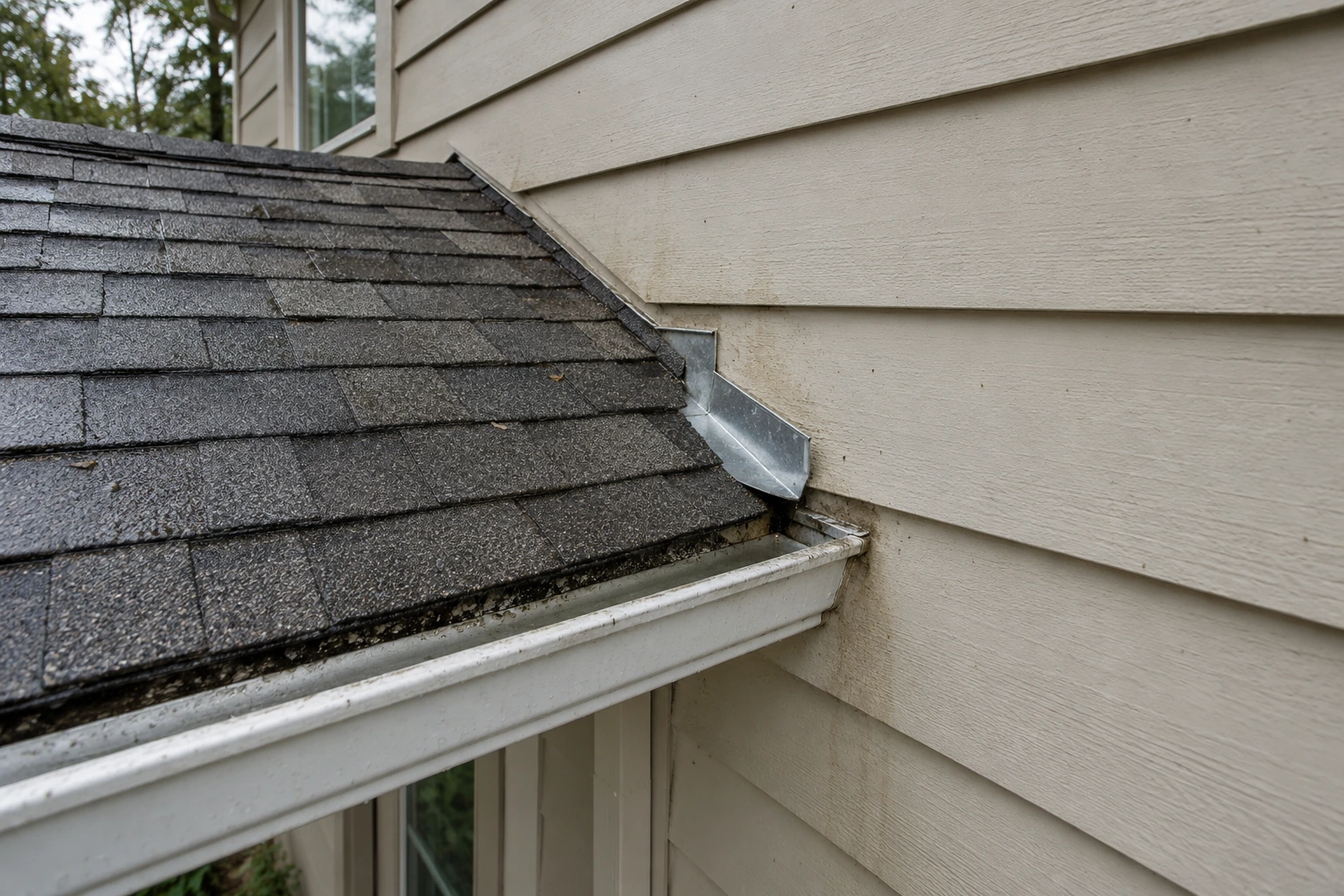
A stain keeps returning below the same roof corner. You clean the siding, check the gutter, and watch it reappear after another rain. The shingles above may look ordinary, which makes it hard to understand why this one patch of wall stays wet. If a lower roof ends against a taller wall, missing kickout flashing is one detail worth having checked.
This small diverter helps send concentrated roof runoff away from the wall and into the gutter. When it is absent or poorly connected, the repair question extends beyond the visible stain: where is the water going, and what has it reached behind the exterior finish?
Kickout Flashing Has a Different Job From Step Flashing
On an asphalt-shingle roof, step flashing consists of overlapping pieces woven into the shingles along an adjoining wall. Kickout flashing belongs at the bottom of that junction, where it turns the runoff outward before it can spill down the continuing wall. Drip edge, by comparison, runs along the roof perimeter and helps direct water away from the roof edge. These details work together, but one does not replace another. A gutter beside the wall still needs water to reach it through a properly detailed transition.
Why a Missing Diverter Can Wet More Than the Siding
Picture rain traveling down the narrow line where a sloped roof meets a wall. That junction collects runoff and delivers it to a small area at the bottom. Without a suitable kickout, the flow can wash the wall below instead of turning into the gutter.
Some water may remain on the exterior, leaving a visible trail. Water that gets behind the siding or other cladding must be managed by the wall’s concealed drainage layers and flashing. Repeated wetting at a poorly detailed junction can reach sheathing or framing, even when the outer surface looks reasonably intact. Building Science Corporation’s documented investigation of a roof-to-wall junction shows why the visible finish alone cannot establish the condition underneath.
Clues That Deserve a Closer Look
The location of a stain matters more than its color. A recurring streak directly below the end of a roof-to-wall junction is a useful clue, especially if you can see runoff taking that route during rain.
Peeling paint, swollen trim, or deterioration near a window below the junction can add to the concern. These observations do not prove that kickout flashing is missing, and similar symptoms can have other causes. The Building America Solution Center illustrates wall and window damage beneath roof corners lacking kickout flashing. Its examples help explain the pattern, rather than provide a diagnosis for every stained wall.
Take photos from the ground or another safe viewpoint, including the roof corner, gutter end, and wall below. Note whether the mark grows after rain and whether you have noticed moisture indoors in the same area. Avoid climbing onto the roof or pulling siding loose to investigate; concealed connections need a closer professional assessment.
Why More Caulk May Leave the Water Path Unchanged
A bead of sealant cannot provide the outward turn that missing kickout flashing was meant to create. Nor does attaching a small metal tab over the siding establish that water behind the cladding will drain safely. Sealants can have legitimate uses in a specified flashing detail, but the repair still needs compatible materials and correctly overlapped connections. Repainting the stain or adjusting a gutter without checking that junction may leave the original runoff path in place.
What a Useful Inspection Should Establish
Start by asking the roofer to show you where the roof-to-wall runoff leaves the junction. Is a kickout present, is it damaged, and does its shape actually direct water away from the wall? A visible piece of metal is only part of the answer.
The adjoining step flashing and wall drainage layer also need attention. Building America guidance emphasizes integrating flashing with both roof and wall layers so water drains down and outward instead of behind the assembly. Some of those connections may be concealed by siding, so a visual inspection has limits. Ask what can be confirmed without opening the area and what additional access would be needed to assess suspected damage.
The assessment should also consider nearby gutter connections, wall openings, and other plausible entry points. If moisture has already reached interior finishes, the explanation should connect that evidence with the suspected exterior water path before a repair scope is settled.
What a Lasting Kickout Flashing Repair May Involve
The size of the flashing piece does not tell you how much work the repair will require. In an existing home, access may involve lifting shingles and removing enough wall cladding to reach the concealed drainage layers. Damaged sheathing or other affected materials may need repair before the junction is closed. Building America’s guidance for existing homes describes flashing replacement as a possible stand-alone retrofit, so this defect does not by itself establish that a full roof replacement is necessary.
A useful proposal should explain both the flashing correction and any work needed to reach or restore the surrounding materials. If siding, stucco, or concealed wall damage is involved, ask who will handle that portion and how the roofing and wall work will be coordinated. The appropriate approach depends on the wall construction and the condition uncovered, rather than a standard promise that every missing diverter is a simple surface repair.
Have the Roof Corner Checked Before Covering the Stain
If you suspect missing kickout flashing at your Spring or North Houston home, Royal Crown Roofing can evaluate the roof-to-wall junction and discuss the roofing work it may need. Review the company’s roof repair services, then contact the team to arrange an inspection. Understanding where the water is going gives you a better basis for deciding what needs repair and whether another trade should be involved.