
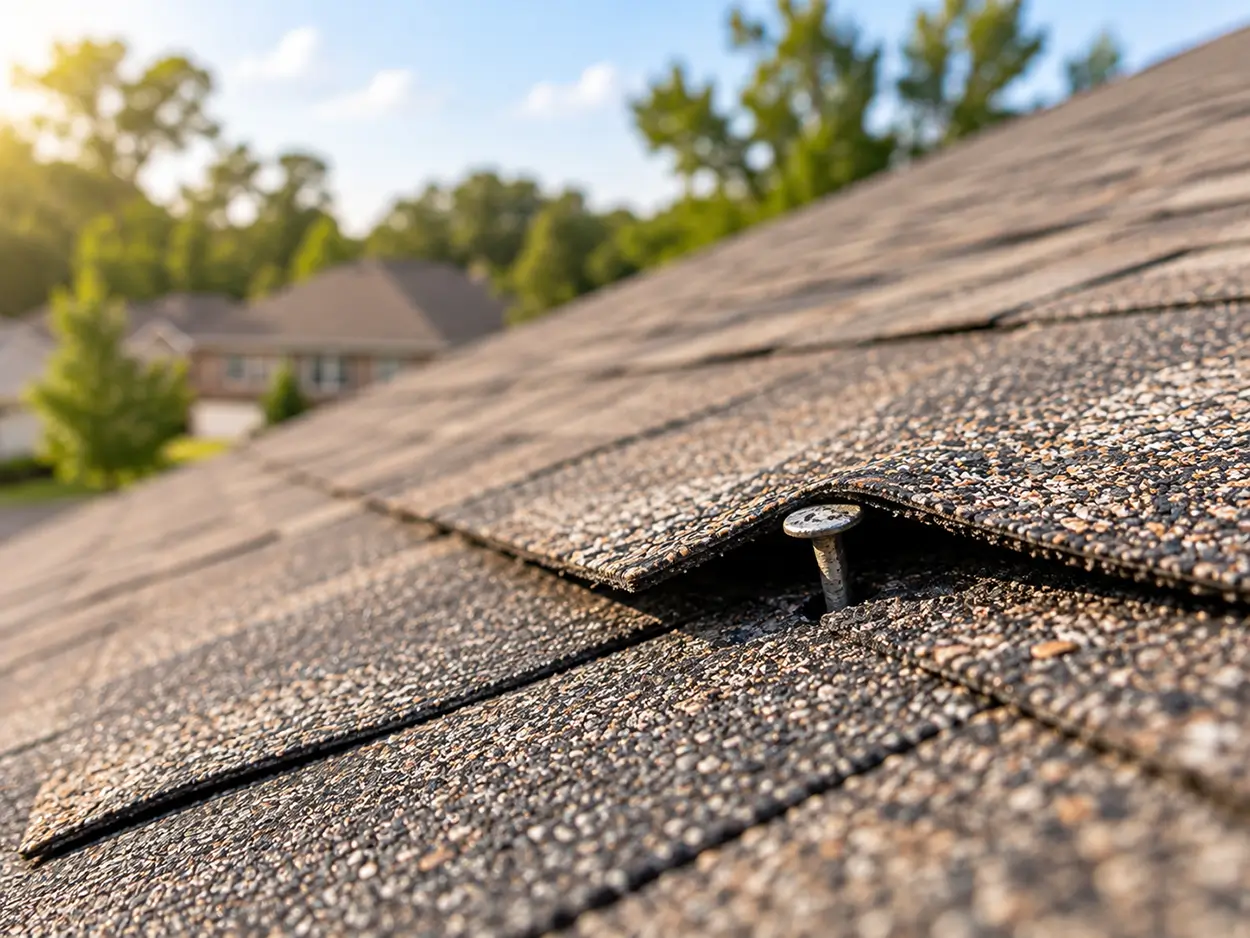
A raised spot in an otherwise flat shingle roof can be easy to dismiss. From the ground, it may look like a small bump or a shingle edge that is sitting a little higher than the others. If that bump is being pushed up by a roofing nail, however, the issue is worth understanding before weather has more time to work on it. The good news is that one small raised area does not automatically mean the entire roof is failing.
Roof nail pops are often a localized fastener problem, but the visible bump is only part of the story. What matters is why the fastener moved, whether the shingle has been damaged, and whether the nail is still securing the roofing material the way it should. Those answers determine whether the repair stays small or whether a broader issue needs attention.
What Is a Roof Nail Pop?
A roof nail pop happens when the head of a roofing nail rises above the surface where it was originally seated. The nail may push against the underside of a shingle, create a noticeable bump, or eventually break through the shingle above it. Asphalt shingles depend on properly placed fasteners to remain secured to the roof deck, and manufacturers provide defined fastening areas and patterns for that reason. Once a fastener has backed out far enough to lift or puncture the shingle, the roofing detail is no longer behaving exactly as it was installed.
Why Do Roofing Nails Back Out?
There is no single cause behind every nail pop. APA, The Engineered Wood Association, uses the terms nail “pop” and “backout” for nail heads that protrude above wood after installation and notes that drying of wet lumber can contribute to the condition. As wood loses moisture and shrinks along the nail shank, more of the nail head can become exposed even though the nail point has not moved the same distance.
Repeated moisture changes can matter as well. Wood framing and sheathing respond to environmental moisture, and APA notes that repeated wetting and drying can contribute to cumulative backout. This does not mean ordinary humidity inevitably pushes roofing nails upward, but it does explain why wood movement is one factor a roofer may consider when several fasteners are behaving the same way. Roof sheathing itself can also expand and contract as moisture conditions change, which is one reason proper panel installation and spacing matter.
Installation quality is another piece of the puzzle. Asphalt-shingle manufacturers specify where fasteners belong, while the International Residential Code requires roofing nails of sufficient length to penetrate the sheathing as prescribed. A nail that is too short, misses solid support, or is poorly seated may be more vulnerable to movement later.
What Does a Nail Pop Look Like?
The first sign may be subtle enough that you notice it only because sunlight hits the roof from a different angle. One shingle can develop a small hump, a raised edge, or a round bump where the nail underneath is pressing upward. In a more advanced case, the nail head may actually break through the surface. Nearby shingles can still look perfectly normal, which is why the defect may seem insignificant at first.
A bump alone does not prove that a roofing nail is responsible. Shingles can also look uneven when roof decking moves or buckles, so a visual symptom should lead to an inspection rather than a snap diagnosis.
Can Roof Nail Pops Cause Leaks?
They can, but the risk depends on what the moving fastener has done to the roofing system. Asphalt shingles are installed in overlapping layers to shed water, and a nail that lifts a shingle can interrupt that flat, sealed surface. If the nail punctures the shingle above it, an opening may be exposed directly to rain. If it simply raises the shingle, wind-driven water may have an easier path underneath than it did before. A nail can also begin backing out before any water has entered, so finding one does not mean a leak has already occurred.
That distinction is useful because early attention can keep the conversation focused on a small repair rather than on damage that developed later. If an interior stain is already present, the popped nail may be part of the investigation, but it should not automatically be blamed for every drop of water nearby. Roof leaks can travel along decking and framing before becoming visible inside the home.
Does One Nail Pop Mean You Need a New Roof?
Usually, one isolated nail pop is not enough information to justify a roof replacement. The condition of the surrounding shingles and roof deck matters far more than the existence of one raised fastener.
This is where a little perspective helps. Seeing a nail push upward through a shingle can make a homeowner wonder whether the original installation was poor or the roof is beginning to fail everywhere. Sometimes the answer is much less dramatic: one fastener has lost its hold while the surrounding roof remains serviceable. A careful inspection can separate those situations without turning a small defect into a much larger recommendation. That is especially important when the roof is otherwise performing well.
Widespread nail pops deserve a different level of attention. When raised fasteners appear across several roof areas, the roofer may need to look for a larger pattern involving fastening, decking, framing, or moisture conditions rather than treating every nail as an unrelated event. The pattern matters more than the number alone.
Why Hammering the Nail Back Down May Not Solve the Problem
Tapping a raised nail back into place may make the bump disappear, but appearance is not the same thing as a lasting repair. The original hole may no longer grip the fastener well, the shingle above it may already be punctured, and the reason the nail moved may still be present. If a new fastener is needed, it must be placed where it can achieve proper holding power and where the shingle can again be secured according to the roofing manufacturer’s instructions. The weather protection above that fastening point also has to be restored.
Sealant can be useful in roofing when it is part of an appropriate repair detail, but it cannot restore holding strength to a loose nail. Covering an exposed head without correcting the fastening problem may hide what you can see while leaving the underlying issue unchanged. That is why the repair should start with the condition of the fastener, shingle, and deck rather than with whatever product is easiest to apply.
What a Roofer Should Check
A good inspection looks at more than the nail head. The roofer should determine whether the shingle has been punctured or lifted, whether the fastener was placed in the intended nailing area, whether its penetration appears adequate, and whether the surrounding shingles remain secure. The roof deck should also be checked for softness, swelling, deterioration, or unusual movement that could affect fastener holding. If several nail pops are present, their locations may reveal whether the problem follows a decking seam, a framing line, an older repair area, or no obvious pattern at all. That broader view is what keeps a small visible symptom from being treated in isolation.
What Homeowners Can Safely Look For
You do not need to climb onto the roof to notice that something has changed. From the ground, an upper window, or another safe vantage point, watch for small raised sections of shingles, localized bumps, or an exposed nail head that reflects light differently from the surrounding surface. A photo taken safely from the same location can help you tell whether the area is changing.
Inside the house, pay attention to new ceiling stains, damp attic insulation, or moisture that appears after rain near the same general roof area. Those signs do not prove that a nail pop is the source, but they give the roofer useful context when tracing the problem. If the bump is difficult to see from the ground, there is little value in climbing the roof simply to confirm it yourself. Sloped roofs are not a good place to investigate a small defect without the right equipment and experience.
When Roof Nail Pops Should Be Repaired
A nail pop deserves prompt attention when the nail is exposed, the shingle has been punctured or lifted, or water intrusion is suspected. Those conditions have moved beyond a harmless visual irregularity.
Even without a visible leak, an evaluation can make sense because the repair is easier to judge before moisture complicates the picture. One isolated pop may require only a focused repair if the surrounding materials are sound. Several pops, a damaged deck, or repeated signs of moisture may justify a broader inspection before anyone decides what work is appropriate. The recommendation should follow what the roof actually shows, not a predetermined sales outcome.
For homeowners, the useful question is not whether every raised nail is an emergency. It is whether the shingle is still secured and watertight, and if not, what the smallest correct repair looks like.
Need Help With Roof Nail Pops in Spring, TX?
If you have noticed roof nail pops, Royal Crown Roofing can inspect the area and explain whether the problem is isolated or part of a larger roofing issue. Visit the Royal Crown Roofing homepage, review its roof repair services, or see its Spring roofing services to understand what failed and what repair the evidence supports.